Running a Metin2 private server without active protection usually becomes visible within days. Economy inflation accelerates, PvP complaints increase, farming routes become predictable, and staff time shifts from development to manual investigations.
Most operators eventually discover the same issue: no single detection method is enough on its own. Packet checks catch one category of abuse, memory integrity catches another, and behavior analysis often exposes what neither can reliably identify in isolation.
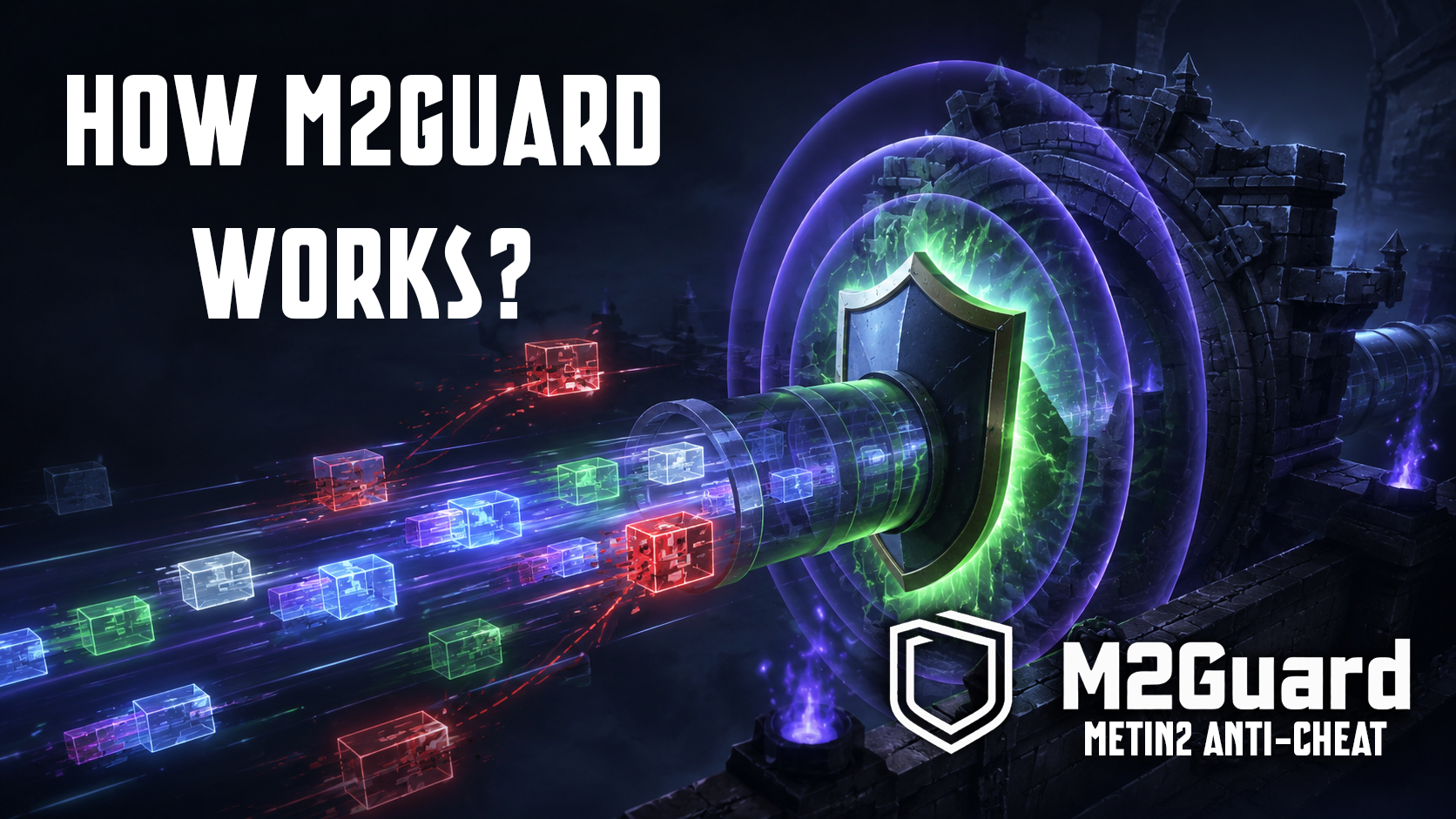
M2Guard was designed around that operational reality. Instead of relying on a single trigger or visible client check, it combines several validation methods that support each other and give server administrators usable evidence before action is taken.
Why traditional checks stop working on Metin2 p servers
Older Metin2 anti-cheat implementations often focused on isolated signatures or static client verification. That approach creates two long-term problems for a live server:
- False positives increase after client updates or custom modifications
- Known patterns become predictable and easier to avoid
Private servers also operate differently from official infrastructure. Custom systems, modified binaries, unique packet flows, offline shops, dungeon automation, and event scripts all create edge cases that generic solutions may not understand correctly.
As a result, server-side validation becomes just as important as client monitoring.
M2Guard approaches detection as a combination of:
- Client integrity monitoring
- Packet timing and consistency checks
- Behavior-based analysis
- Administrative review workflows
- Centralized logging and escalation rules
That combination matters because suspicious activity rarely appears as a single event. More often, it appears as a pattern over time.
Memory integrity and client monitoring
One of the first areas administrators focus on is unauthorized client manipulation. In practice, this means monitoring whether important game structures, execution paths, or runtime states behave differently than expected.
M2Guard performs integrity-oriented checks intended to identify abnormal client conditions without depending entirely on static signatures.
For operators, the important part is not the technical buzzwords. It is the outcome:
- Reduced reliance on manual player reports
- Earlier detection of abnormal client states
- Better visibility into repeated incidents tied to accounts or hardware identifiers
On heavily populated Metin2 private servers, this becomes especially useful during events and high-farm periods where staff cannot manually observe every map.
Client-side monitoring alone is never treated as final proof. Instead, M2Guard correlates findings with server-side activity before escalation rules are applied.
Packet timing and movement validation
Packet validation is still one of the most practical defensive layers for a Metin2 p server because many gameplay actions eventually translate into measurable timing behavior.
Examples include:
- Movement sequences arriving outside expected timing ranges
- Repeated action intervals with unrealistic consistency
- Combat actions occurring faster than valid animation states permit
- Abnormal synchronization between client actions and server responses
Instead of relying only on hard limits, M2Guard can evaluate patterns over multiple events. This helps reduce accidental punishments caused by latency spikes or unstable regional routing.
For administrators, this matters because aggressive thresholds often create unnecessary support tickets. A system that records context before escalation produces cleaner moderation decisions.
Behavior analysis and economy protection
Not every problem originates from direct client modification. Some of the most damaging cases on Metin2 private servers involve automated farming behavior that blends into normal gameplay unless activity is reviewed over time.
Behavior analysis focuses on identifying patterns that differ from legitimate player activity.
That can include:
- Unusual farming repetition across long sessions
- Highly consistent route timing
- Non-human interaction intervals
- Suspicious trade and item transfer chains
- Multi-account coordination patterns
For server owners, the economy impact is usually more important than the technical method being used. Once automated farming affects upgrade materials, Yang generation, or item circulation, player trust starts to decline.
M2Guard logging allows administrators to review how suspicious activity developed over time rather than reacting to a single isolated alert.
This is especially important when dealing with veteran players or guild disputes where enforcement decisions may later be challenged.
A practical moderation scenario
Consider a common support situation on a mid-sized Metin2 private server.
Multiple tickets report that a character has been farming the same map continuously for extended periods with nearly identical movement timing. No direct memory violation appears initially, and staff observation alone is inconclusive.
Instead of issuing an immediate punishment, administrators review:
- Packet timing irregularities across several hours
- Route consistency logs
- Repeated combat interval patterns
- Trade activity linked to secondary accounts
- Historical detection flags tied to the same environment
Individually, none of those entries may justify action. Together, they create a reliable operational picture.
That distinction is important because mature ban workflows depend on evidence correlation rather than isolated triggers.
Why server-side validation still matters
One mistake newer operators make is assuming the client should carry most of the enforcement responsibility.
In reality, server-side validation remains critical because the game server ultimately controls progression, rewards, combat state, and economy integrity.
M2Guard complements that model by helping administrators identify situations where:
- Client behavior does not align with expected gameplay rules
- Packets arrive in invalid sequences
- Character actions exceed permitted timing windows
- Player activity patterns become statistically abnormal
For developers maintaining custom systems, this also reduces dependence on manual scripting fixes after abuse reports appear.
Additional operational documentation and implementation notes can be found in the Anti-triche Metin2 : termes, questions et réponses M2Guard.
Reducing staff workload without over-automation
Fully automated punishment systems sound attractive until they generate false bans during peak activity.
Experienced GMs usually prefer a staged process:
- Detection
- Correlation
- Review
- Escalation
- Enforcement
M2Guard is intended to support that workflow rather than replace staff judgment entirely.
This becomes particularly important on servers with custom PvP balancing, regional latency differences, or unusual gameplay systems where rigid automation can create moderation problems.
Instead of forcing immediate bans, administrators can use logged events to determine whether:
- The activity is persistent
- Multiple detection categories align
- The account has prior incidents
- The behavior impacts the economy or competitive balance
That approach typically leads to cleaner enforcement history and fewer unnecessary appeals.
Operational checklist for server owners
Anti-cheat results depend as much on operational discipline as the detection system itself.
For Metin2 private server operators, the following practices are usually more effective than increasing punishment severity alone:
- Review detection logs daily during major events
- Correlate economy anomalies with farming activity
- Separate automated flags from final ban decisions
- Track repeat offenders across linked accounts
- Document enforcement standards for GM consistency
- Validate custom systems after major client updates
- Monitor packet anomalies after network or hosting changes
Consistent review procedures often prevent larger economy and reputation issues later.
Monitoring and long-term maintenance
Security on a live Metin2 p server is not a one-time setup task. Detection quality depends on ongoing review, tuning, and adaptation to gameplay changes.
That is especially true for servers running:
- Custom dungeons
- Modified skill systems
- Unique movement mechanics
- Extended inventory systems
- Offline shop variations
Changes in gameplay systems can alter packet behavior and player interaction patterns. Monitoring rules should evolve alongside the server itself.
Operators comparing deployment approaches or maintenance expectations can review additional details on the pricing page or follow technical updates through the M2Guard technical blog.
FAQ
Does M2Guard rely only on client detection?
No. The system combines client monitoring with server-side validation, packet analysis, and behavior-oriented review processes.
Can packet validation reduce false positives?
Yes, especially when timing analysis is evaluated across multiple events instead of relying on single-trigger enforcement.
Why is behavior analysis important for Metin2 private servers?
Many economy-related issues appear through long-term farming and interaction patterns rather than direct client integrity violations alone.
Should bans be fully automated?
Most experienced administrators prefer staged enforcement with manual review for higher-risk decisions, particularly on competitive servers.
Does anti-cheat maintenance stop after installation?
No. Detection rules and validation logic should be reviewed regularly as gameplay systems, client files, and server infrastructure evolve.